
| Date | 4th, Jun 2022 |
|---|
In December 2021, NASA awarded a total of $415 million to three companies — Blue Origin, Nanoracks and Northrop Grumman — that are leading efforts to build private space stations in Earth orbit. NASA’s agreements with Blue Origin, Nanoracks, Northrop Grumman and Axiom represent the first phase of a planned two-phase effort to spur the development of commercial low-Earth orbit destinations (CLD) during the 2020s. The first phase is expected to continue through 2025. The second phase in this plan will be similar to the approach NASA has taken with private crew transportation services to and from the ISS. NASA paid billions to SpaceX and Boeing to develop crew launch capability and for launch services. In May 2022, SpaceX has just been given a five-manned launch extension.
NASA has a separate agreement with Houston-based company Axiom Space, which will launch multiple modules to the International Space Station (ISS) starting in late 2024. These modules will eventually detach from the orbiting lab, forming a privately operated “free flyer” in orbit.
Nanoracks Plan
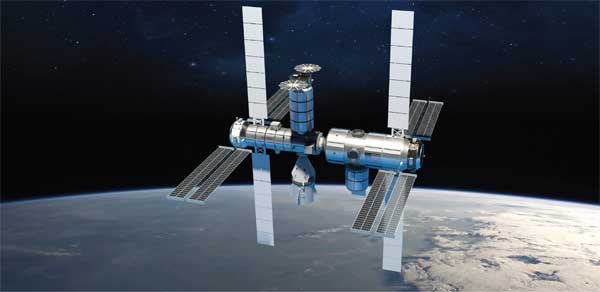
Nanoracks, in collaboration with Voyager Space and Lockheed Martin [NYSE: LMT], has formed a team to develop the first-ever free flying commercial space station. The space station, known as Starlab, will be a continuously crewed commercial platform, dedicated to conducting critical research, fostering industrial activity, and ensuring continued U.S. presence and leadership in low-Earth orbit. Starlab is expected to achieve initial operational capability by 2027. Nanoracks has been awarded $160 million by NASA to start developing their space station plan. The rendering at the top is the current notional Nanorack station design.
The basic elements of the Starlab space station include a large inflatable habitat, designed and built by Lockheed Martin, a metallic docking node, a power and propulsion element, a large robotic arm for servicing cargo and payloads, and a state-of-the-art laboratory system to host a comprehensive research, science, and manufacturing capability. Starlab will be able to continuously host up to four astronauts for conducting critical science and research.
Axiom Space
Axiom Space is putting the first pieces of fabricated flight hardware together. In early 2023, the assembled module will move to Houston where they will complete final assembly and integration to prepare for a late 2024 launch of the first section of the next-generation platform for breakthrough innovation in low-Earth orbit.

Grumman Plan
Grumman and Dynetics are working on a space station. The free flyer commercial destination design will provide the base module for extended capabilities including science, tourism, industrial experimentation, and building of infrastructure beyond initial design. Building on Northrop Grumman’s commercial spacecraft experience with the Cygnus spacecraft and the Mission Extension Vehicle (MEV) as well as the in-production Habitation and Logistics Outpost (HALO). The proposal by NG Space is not as ambitious in scope as those from Blue Origin and Nanoracks, since it proposes both smaller payload volume and habitable volume. They only plan to reach the Preliminary Design Review (paper study phase) at the end of the current $125 million in funding.

Brian Wang is a Futurist Thought Leader and a popular Science blogger with 1 million readers per month. His blog Nextbigfuture.com is ranked #1 Science News Blog. It covers many disruptive technology and trends including Space, Robotics, Artificial Intelligence, Medicine, Anti-aging Biotechnology, and Nanotechnology.
Known for identifying cutting edge technologies, he is currently a Co-Founder of a startup and fundraiser for high potential early-stage companies. He is the Head of Research for Allocations for deep technology investments and an Angel Investor at Space Angels.
A frequent speaker at corporations, he has been a TEDx speaker, a Singularity University speaker and guest at numerous interviews for radio and podcasts. He is open to public speaking and advising engagements.
